
Lavandula Angustifolia (Lavender)
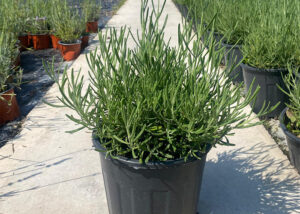
- Diseases and Pests: Root rot and leaf spot disease and caterpillar pest are seen.
- Scientific name: Lavandula Angustifolia
- In colloquial language: English Lavender
- Homeland: Mediterranean Region Countries, Canary Islands and India
- Family: Lamiaceae
- Height: 1-1.5 m
- Leaf: Leaves are thin and long, grayish in color.
- Flower: It occurs in June-July. Flowers are densely spike-shaped on a long stem, pleasantly scented and dark purple-purple in color.
- Resistance: Cold resistance 8A (-12.2°C – -9.5°C), heat resistance H4A (+38.0°C – +40.7°C)
- Light Requirement: Full sun
- Soil Requirement: Prefers permeable soils. It is damaged in heavy and moist soils.
- Water Requirement: Requires moderate water. Excessive watering should be avoided.
- Fertilization: Applying compound fertilizer in spring positively affects plant development.
- Pruning: Dried flowers should be pruned to extend the flowering period.
- Heat Requirement: Can grow in arid areas.
Lavandula Dendata (Grey Lavender)
- Scientific name: Lavandula dentata
- Public: French Lavender
- Homeland: Mediterranean basin, Eritrea, Ethiopia, Yemen and Arabian Peninsula
- Family: Lamiaceae (Lamiaceae)
- Height: 60 cm
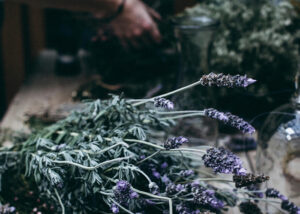
- Leaf: Gray-green, linear or lance-shaped, toothed edges, slightly hairy texture
- Flower: Blooms in blue, purplish or red colors in June-July
- Resistance: Cold resistance 8A (-12.2°C – -9.5°C), heat resistance H4A (+38.0°C – +40.7°C)
- Light Requirement: Sunny
- Soil Requirement: Well-drained, sandy or clayey sandy soil
- Water Requirement: Avoid overwatering avoid
- Fertilization: Fertilize once a month with a balanced fertilizer during the growing season
- Pruning: : Prune after flowering in spring.
- Diseases and Pests:
- Temperature Requirements:
Aloysia Triphylla (Lemon Balm)
- Scientific name: Aloysia Triphylla
- In the public language: Lemon Balm
- Homeland: South Africa and the Mediterranean basin.
- Family: Verbenaceae
- Height: 1 m
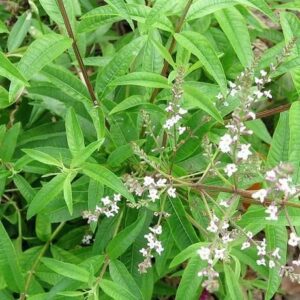
- Leaf: Its oval-shaped, toothed and hairy leaves have a lemon scent. It is added to salads, some foods and drinks to give it a pleasant lemon scent. It can be brewed and drunk as lemon balm tea.
- Flower: Its flowers are small, white or pale yellow, and bloom in the summer months. The flowers are usually found in clusters and have a pleasant scent.
- Resistance: -3°C
- Light Requirement: Full sun or semi-shade
- Soil Requirement: It is not selective in terms of soil.
- Water Requirement:
- Fertilization:
- Pruning: All weak, weak branches should be pruned from the bottom at the end of winter.
- Diseases and Pests:
- Temperature Requirement:
Mentha Piperita (Menthol Mint)
- Scientific name: Mentha Piperita
- Public Language: Menthol Mint
- Homeland: Mediterranean region, especially Anatolia and Egypt.
- Family: Lamiaceae (Lamiaceae)
- Height: 30-80 cm
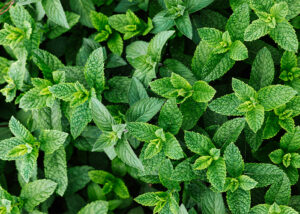
- Leaf: Its leaves are usually hairy and serrated in a reciprocal manner. Leaf colors can be in various colors such as dark green, grayish, purple, blue and sometimes pale yellow. Its leaves have an aromatic and slightly bitter taste and cause a cold taste in the mouth. It is generally used as a flavoring and additive.
- Flower: Flowers can be in colors such as purple, pink, white, gray.
- Resistance:
- Light Requirement: Full sun
- Soil Requirement: Not selective in terms of soil.
- Water Requirement: Requires moderate water. Excessive watering should be avoided.
- Fertilization:
- Pruning:
- Diseases and Pests: The most dangerous of the diseases affecting yield and quality in mint is mint rust. May be subject to parasites and pathogens such as fungi, leaf spot, nematodes, viruses, Whiteflies (Aleyrodidae) and Aphids (Aphidoidea).
Ocimum Basilicum (Basil)
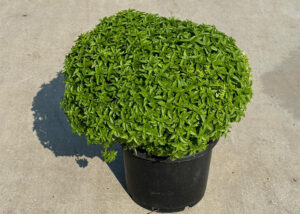
- Scientific name: Ocimum Basilicum
- In common parlance: Basil
- Homeland: Southeast Asia
- Family: Lamiaceae
- Height: 20 – 60 cm
- Leaf: The leaves, which vary in color from light green to dark green, are soft and are widely used both in cuisine and alternative medicine.
- Flower: Some have white flower color and some have pink-light purple tones (the flowers of sweet-flavored basils with green leaves are usually white).
- Resistance: Its life span is from spring to winter at most.
- Light Requirement: Full Sun or Semi-Shade
- Soil Requirement:
- Water Requirement:
- Fertilization:
- Pruning:
- Diseases and Pests:
Rosmarinus Officinalis (Rosemary)
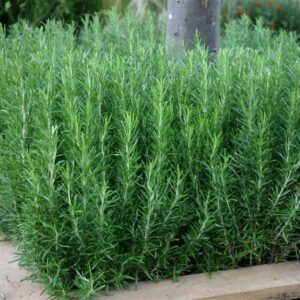
- Scientific name: Rosmarinus Officinalis
- Public Language: Rosemary
- Homeland: Southern Europe and Western Asia around the Mediterranean.
- Family: Lamiaceae (Lamiaceae)
- Height: 1 – 1.5 m
- Leaf: It does not shed leaves in winter. Its fragrant leaves are thin and are between 1cm and 3cm long. The leaves are lush green on new shoots. They turn a slightly grayish pale green color as they age.
- Flower: It blooms intermittently or continuously between autumn and spring. Its flowers are small and lilac-like in color.
- Resistance: -15°C
- Light Requirement: Full Sun or Half Shade
- Soil Requirement: It does not like acidic soil. It is compatible with neutral and alkaline soils and grows well. It is compatible with salty soils. It is important that the soil is well drained (because it does not grow well in heavy clay soils).
- Water Requirement: Watering is only important in the first year. After the roots are well attached to the soil in the first year or two, you can do without watering at all in the following years. In fact, although rosemary is incredibly resistant to drought, watering occasionally throughout the summer is necessary for its development. Frequent watering, however, does not speed up development. Watering occasionally, when the soil is completely dry, is sufficient.
- Fertilization: Does not require fertilizer
- Pruning: It can be a hedge plant. Since it has very thin and dense branches, it can be pruned to give geometric shapes such as balls, triangles, or even animal shapes.
- Diseases and Pests:
Rosmarinus Officinalis Prostratus <br>(Rosemary Spreader)
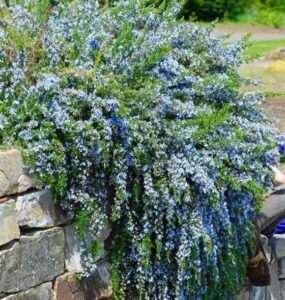
- Scientific name: Rosmarinus Officinalis Prostratus
- In Folk Language: Spreading Rosemary
- Homeland: Mediterranean
- Family: Lamiaceae (Lamiaceae)
- Height: 1 – 1.5 m
- Leaf: The petiole is fibrous and the leaves are spear-shaped, fleshy and green in color. It does not shed leaves in winter.
- Flower: Pale blue and small. Its flowers are in small groups at the ends of branches and in the leaf axils.
- Resistance: -15°C
- Light Requirement: Full Sun or Semi-Shade
- Soil Requirement: It can grow in all types of soil, including dry, calcareous soils.
- Water Requirement:
- Fertilization:
- Pruning:
- Diseases and Pests:
Salvia Farinacea Saga Blue <br>(Sage Blue)
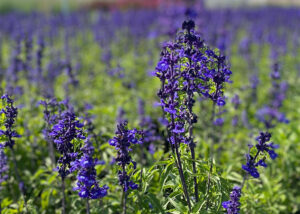
- Pruning: Deep pruning should be done as it frequently passes through its flowers.
- Scientific name: Salvia Farinacea ‘Saga Blue’
- In Folk Language: Blue Sage
- Homeland:
- Family: Lamiaceae (Lambidae)
- Height: 60 – 90 cm
- Leaf: The leaf shape is oval – lanceolate.
- Flower: It blooms from spring to late autumn. Its flowers can be purple, blue, lavander and lilac, and dried and ground flowers and leaves of the plant are used in dyeing. Dyeing is done first by mordanting and then by dyeing.
- Resistance:
- Light Requirement: Full Sun or Semi-Shade
- Soil Requirement: Prefers permeable and moist soil
- Water Requirement:
- Fertilization:
- Diseases and Pests:
Salvia Microphylla Hot Lips <br>(Sage Red)
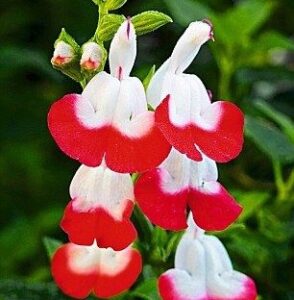
- Scientific name: Salvia Microphylla Hot Lips
- In Folk Language: Red Sage
- Homeland: Southeastern Arizona, east-west and southern Mexican mountains
- Family: Lamiaceae (Lamiaceae)
- Height: 1 – 1.5 m
- Leaf: Leaves may change color in autumn. It is evergreen or semi-evergreen depending on the climate. When its leaves are crushed, they emit a pleasant scent similar to mint and sage.
- Flower: It blooms from the first year. It starts to bloom at the end of May and remains in bloom until the end of autumn.
- Resistance:
- Light Requirement:
- Soil Requirement: It grows well in humus soils. It especially prefers dry soils. It also likes sandy-loam soils rich in lime.
- Water Requirement:
- Fertilization:
- Pruning:
- Diseases and Pests:
Salvia Officinalis (Sage Original)
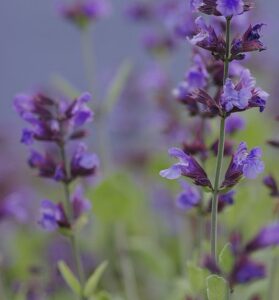
- Scientific name: Salvia Officinalis
- In Folk Language: Original Sage
- Homeland: Mediterranean countries
- Family: Lamiaceae (Lambidae)
- Height: 30 – 75 cm
- Leaf: Gray or gray-green in color and slightly hairy on the surface. The most common use is to consume it as tea. However, it is also dried and used as incense.
- Flower: It blooms between June and August. It has purple-blue flowers. Its flowers attract bees and flies.
- Resistance:
- Light Requirement: Full Sun
- Soil Requirement: It prefers dry soils and does not need additional irrigation, but when irrigated, two or three harvests can be made per year.
- Water Requirement: Sage does not like too much water, so excessive irrigation should be avoided. The soil should be slightly moist.
- Fertilization:
- Pruning:
- Diseases and Pests:
Salvia Vibe Purple
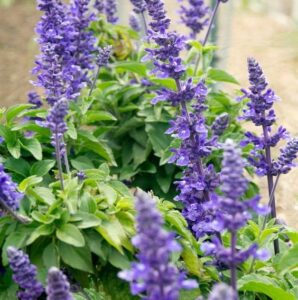
- Scientific name: Salvia Nemorosa
- Public Language: Purple Sage
- Homeland: From Europe to Central Asia
- Family: Lamiaceae (Lamiaceae)
- Height: 30 – 90 cm
- Leaf:
- Flower: It blooms between July and September. Its flowers are blue purple.
- Resistance: -29° C
- Light Requirement:
- Soil Requirement: It prefers moderately rich in nutrients and moderately dry, loose, permeable soil.
- Water Requirement:
- Fertilization:
- Pruning:
- Diseases and Pests:
Thymus SPP
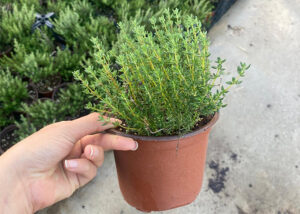
- Scientific name: Thymus SPP.
- In the public language: Thyme
- Homeland: Mediterranean
- Family: Lamiaceae (Lambidae)
- Height: 10 – 40 cm
- Leaf: The leaves are arranged opposite each other in a cross-like manner, the edges are flat. It can usually be consumed as a spice, but it is also used in many areas including pharmacy, cosmetics, food and oil production.
- Flower: It blooms between July and August.
- Resistance: -5°C
- Light Requirement: Full Sun or Semi-Shade
- Soil Requirement: Prefers permeable and moist soil.
- Water Requirement:
- Fertilization:
- Pruning:
- Diseases and Pests: